


I thought about John Hancock and my pal John James the other day while I was voting.
Hancock of course was famous for his writ large signature on the Declaration of Independence…lest King George not notice.
And John James and I go way back to when our kids camped together. These days he spends his summer in North Carolina. And he requested an absentee ballot from the Alachua County Supervisor of Elections in order to do his civic duty back home in GNV.
He almost didn’t get his vote counted.
“I got an email from the Supervisor of Elections stating that a committee had challenged my signature on my vote by mail ballot,” he told me.
“I called and asked for the vote by mail department and the person that answered was so helpful. She checked and my challenged ballot had been reviewed by the Elections office and had removed the challenge, and I was told that my ballot was now approved and would be counted.”
So no harm, no foul. Right?
Still I couldn’t help thinking about John’s brush with disinfranchisement when I showed up to vote, in person.
And they asked for my signature.
On a stylus.
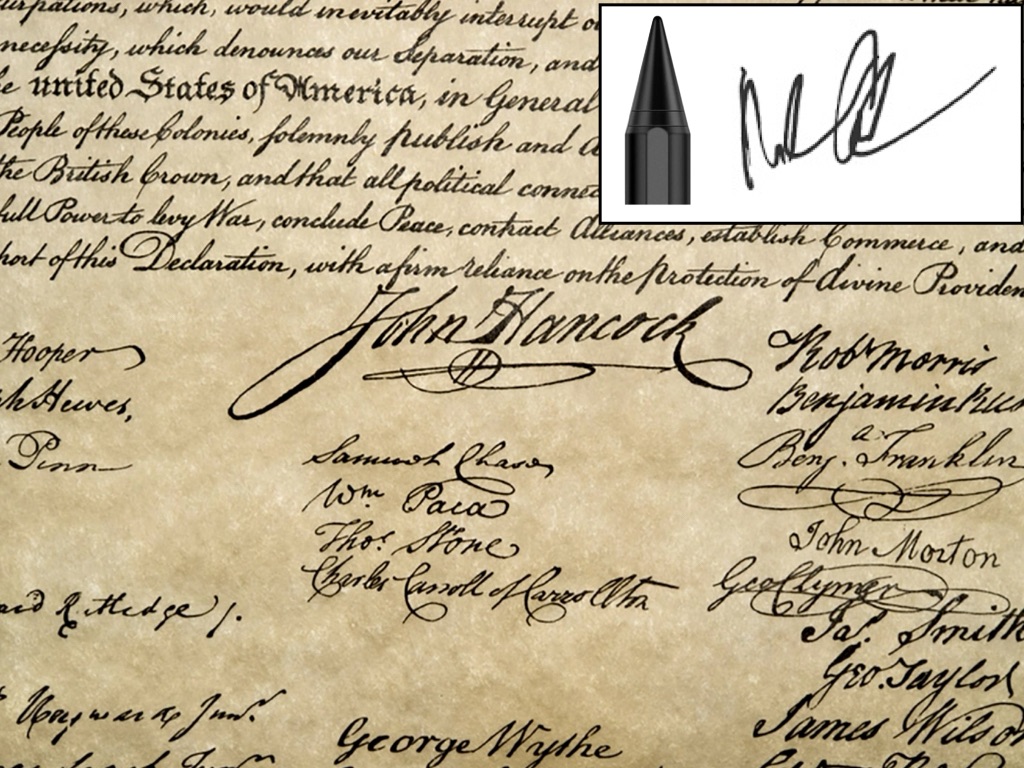
Now I don’t know about you, but in my long history of e-signing I have never once been able to even remotely replicate my, um, John Hancock.
There’s something about a slick screen and the spongy end of a stylus pen that turns my best efforts into so much chicken scratch.
Funny thing is that for all of the illegible scrawls I’ve committed electronically – and there have been a lot of them – I’ve never been challenged on a single one.
I even joked about it to the guy who handed me my ballot. He grinned and said “we have a lot of latitude.”
Maybe. But maybe not.

Still, I suspect that when it comes absentee ballots, the ability to challenge ballot signatures has become just another tool in the voter suppression tool kit.
According to the American Civil Liberties Union, some states are increasingly allowing absentee ballot signature challenges by political operatives.
Disenfranchising a voter should not be done lightly. An official without training in signature or handwriting analysis should not reject a voter’s application or ballot until they notify the voter and give them an opportunity to fix the issue. Without proper notice and opportunity to cure, voters, especially voters with disabilities, elderly voters, trans voters, women voters, ESL voters and military voters, are susceptible to being unfairly excluded from the democratic process.
Absentee ballots are intended to make voting more accessible for qualified voters, not to disenfranchise marginalized populations.
Oh, and among the states that are getting pickier and pickier about signatures is – surprise! – The Free State of Floriduh.
Reports NPR:
A little-known provision in Senate Bill 90, a sweeping voting measure passed by Florida Republicans last year, increased how much input the public can have when it comes to approving signatures on mail ballots.
Under Section 101.572 in SB 90, candidates and political parties can appoint anyone they want to inspect voter signatures. There’s no training requirement and it’s up to supervisors of elections in each of Florida’s 67 counties to set parameters on how that’s going to work.
Of course having in person voters sign electronically is a bureaucratic convenience. And with me standing right there in the room, ID in hand, I suppose my e-chicken scratch didn’t matter.
Still, in Florida’s 2018 elections, more than 32,000 absentee votes were tossed out via signature challenges. Now that we’ve opened the gate for self-styled handwriting experts to intervene I suspect that challenges will escalate considerably come November.
Florida has weaponized voter suppression to a fine art.
What would John Hancock say?

 FreeGNV
They are wasting Election Office resources by raising this NON ISSUE.
>
I’m a poll worker and it can be challenge, especially for people who have had strokes, suffering from Parkinson’s or have a broken hand or arm.