



Listen, anybody who knows me understands that I’m not one of Spiro’s Nattering Nabobs of Negativism. Not for me the sackcloth and ashes prophet of doom, despair and agony on thee (Whoooo) refrain.
Nah, I’m an optimist. I’ll leave it to the rest of the Jaded Punditry Class to predict The End Of The World inevitability of Trump’s vow to bomb Iran back to the Stone Age and risk turning the Strait of Hormuz into an oil-choking shooting gallery.
And so, to cheer everybody up in these dark, dark times I’m rerunning a column I originally wrote for The Sun back in 2019. Somehow, against all odds, it seems wonderfully relevant again.
Always look for the silver lining people. Like me.
***
The law of supply and demand will ultimately throw a monkey wrench into Auto-America’s love affair with the open road.
And that may not be all bad.
In fact, in the long run, it might even turn out to be good for America.
That’s the premise of an oddly optimistic book about the advent of “peak oil”; the notion that all of the easy-to-get-at oil has already been exploited, and from now on, the stuff is only going to get harder to find, harder to extract and, consequently, more expensive to buy.
This in the face of ever-rising global demand for more and more black gold.
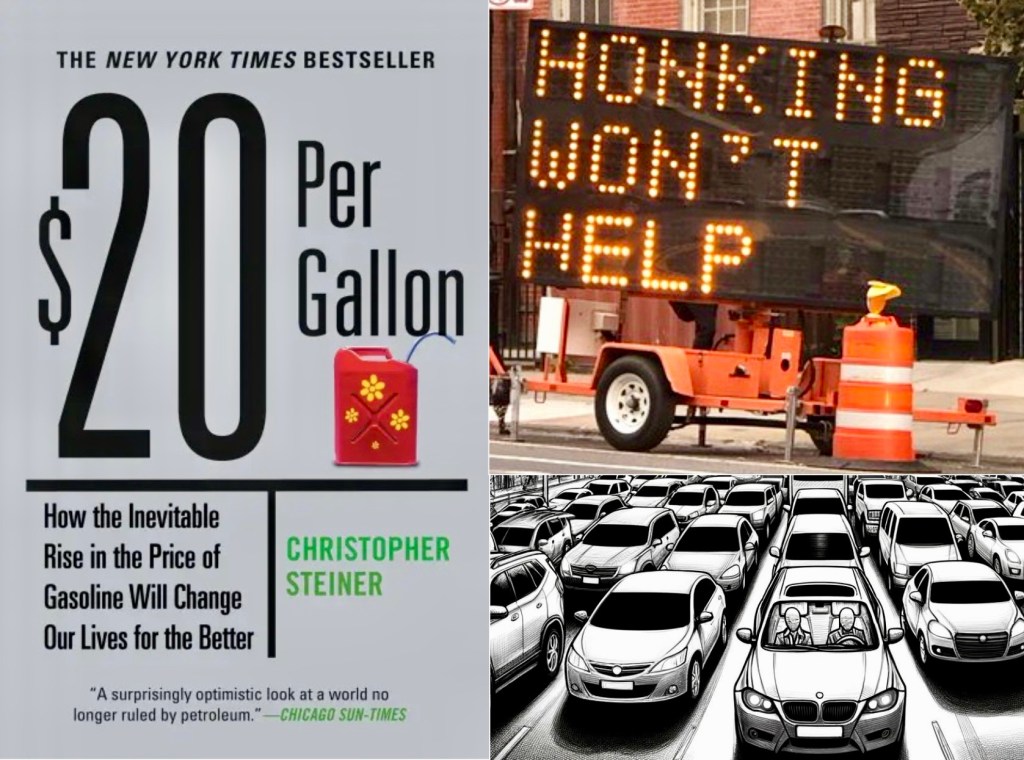
The book’s title is downright scary:
“$20 per gallon.”
But it’s got a reassuring subtitle that sets it apart from most of the doomsday scenarios about peak oil:
“How the inevitable right in the price of gasoline will change our lives for the better.”
He’s kidding, right?
Not.
Christopher Steiner, the author, isn’t some wild-eyed environmentalist. He’s a staff writer for Forbes magazine with a background in civil engineering and a bullish affinity for nuclear energy.
“The rising price of gasoline…,” he writes, “will reshape your house, your car, your town, your stores, your job, your life.
“America has never seen so great an innovation spur as escalating petroleum prices.”
The key phrase there being “innovation spur.”
Some authors, most notably James Howard Kuntzler, have spun peak oil as a one-way ticket back to the dark ages. Steiner begs to differ.
He argues that human beings in general, and Americans in particular, are smart enough, resourceful enough and entrepreneurial enough to adapt to, and even profit from, expensive gas.
Can’t afford an internal combustion engine? Here come the electrics.
Flying too expensive? What about high-speed trains?
No more cheap oil to make cheap plastics? Somebody’s already figured out how to make the stuff from bacteria; and it’s biodegradable to boot.
And we’ve only just begun to scratch the surface on energy conservation; green buildings, factories that power themselves from their own heat waste, and smart electrical grids are the future.
It’s all about the price signals.
Chapters of pain and promise
Steiner divides his chapters into gas price hikes.
“Each increase in price will bring with it new pain that will force us to adapt,” he says.
Chapter $6 a gallon: SUVs disappear from the roads, but mass transit becomes “the absolute belle of the ball.”
Chapter $8 a gallon: Airlines begin to go out of business, but the ones that don’t will develop new generations of fuel-efficient planes.
Chapter $12 a gallon: Suburbs begin to turn into ghost towns, but cities experience a renaissance.
At Chapter $14 a gallon: Manufacturing jobs begin coming back to the U.S. because the cost of shipping becomes prohibitive.
At Chapter $16 a gallon: Hauling fruits, meat, potatoes and tomatoes across the continent and around the world becomes out of the question; giving rebirth to local farming.
At Chapter $18 a gallon: America finally follows Europe and Japan and builds its own network of high-speed railroads.

“We will not eliminate our use of oil; those who say we can are simply deluded,” Steiner argues. “But we can vastly cut our economy’s dependency on it.”
The idea of $6 a gallon gas is scary enough, let alone $20 a gallon. Rising oil prices will inevitably mean the loss of jobs and economic stress for millions of Americans.
“Expensive energy, for some, will be strictly a burden,” Steiner writes. “For others it will be an opportunity for innovation.
It’s human nature, after all.
Invent a better mousetrap.
Build a better widget.
Get over gasoline.

 FreeGNV