

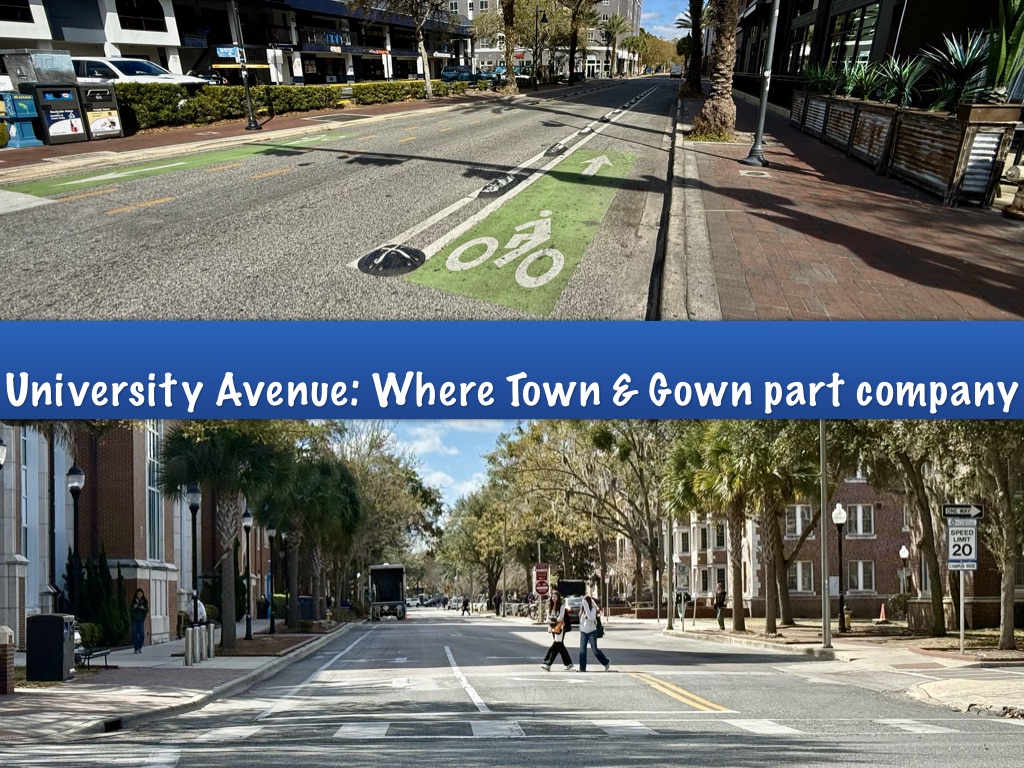
On Wednesday I climbed off my bicycle at the corner of University Avenue and NW 17th Street.
And I had a look at both sides of University.
The City side. And the UF side,
Looking south on campus, where NW 17th becomes Buckman Drive, I saw a distant LED sign asking motorists to: Watch For Pedestrians.
Which, I suppose, is more circumspect than: “Please don’t kill or maim our students.”
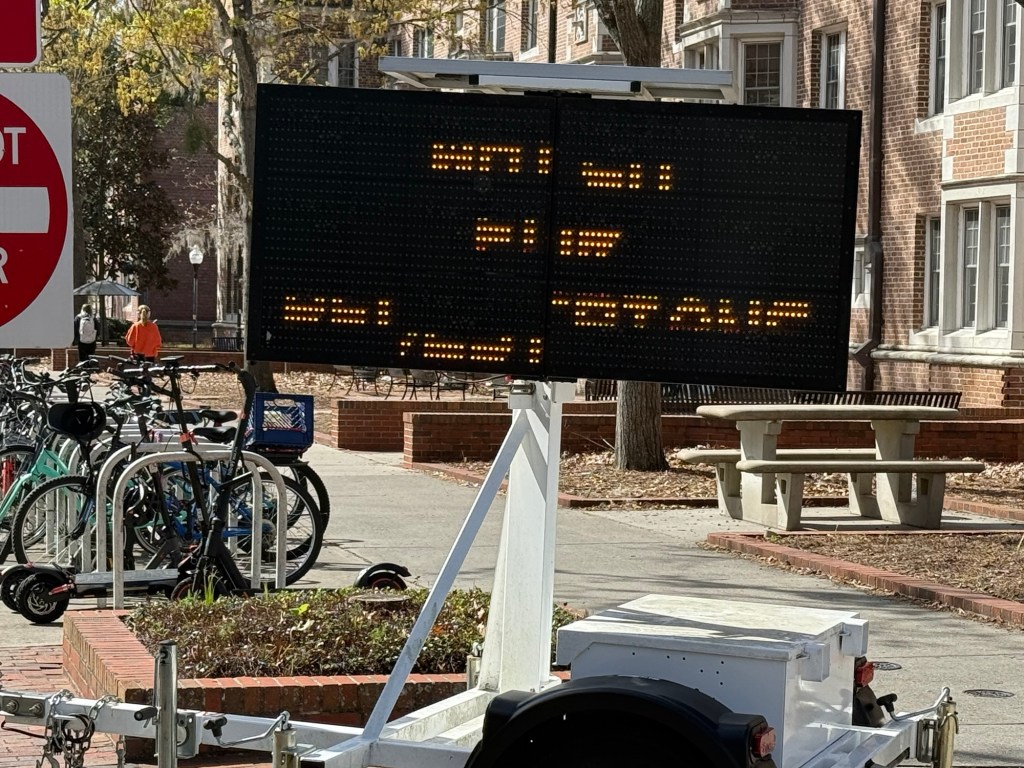
That sign appeared after a 19-year-old student was run over by a box truck on Tuesday. So it was certainly timely.
On any given day UF is teeming thousands of human beings many of whom, at any given moment, are cross-crossing campus, hurrying and scurrying hither and fro.
Which is as it should be.
But there are distractions plenty on any given class day.
So you can’t really expect every walker, cyclists and scooter rider to be aware of, observe and respect the sometimes confusing barriers that have been erected on campus in piecemeal fashion over the years.
Most of them intended to protect vulnerable carbon-based life forms from moving objects comprised of tons of steel.
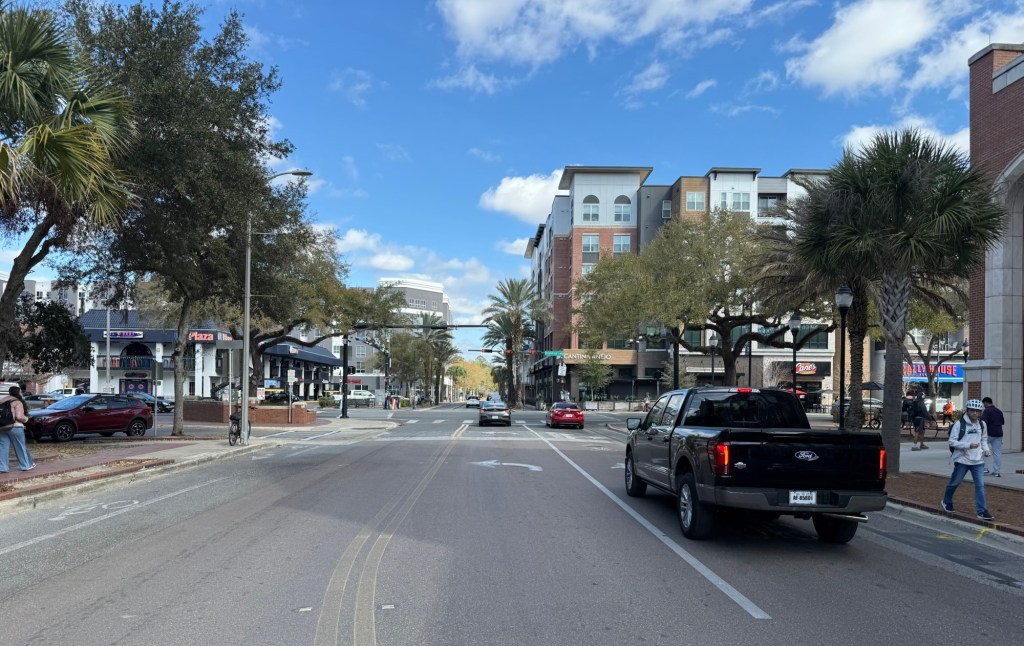
Obviously those protections failed at least one UF student on Tuesday. She was taken to the hospital with life-threatening injuries.
Well, accidents happen. Right?
But accidents by design? Or rather for lack of a safer design?
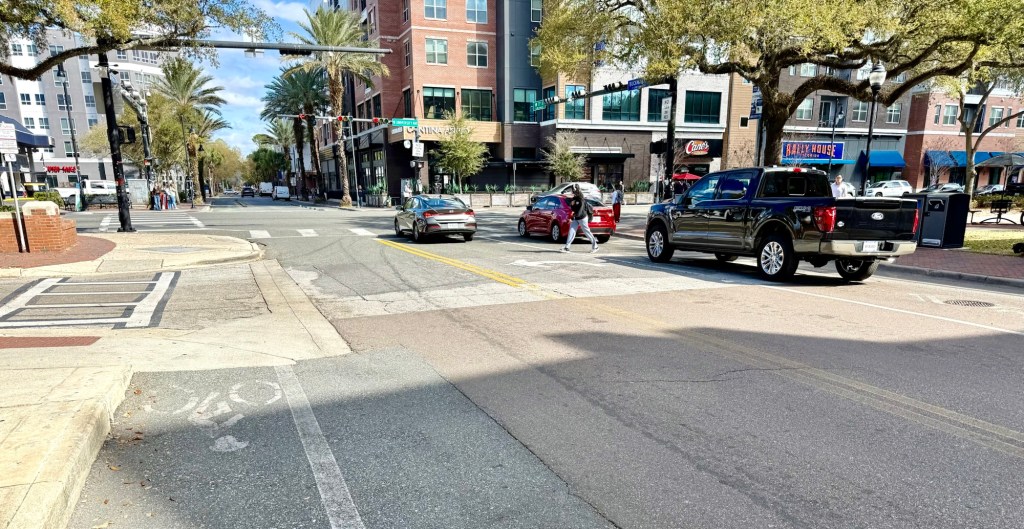
Anyway, I had stationed myself at a corner on University Avenue where NW 17th Street (Town) meets Buckman Drive (Gown).
And I couldn’t help but notice that Town and Gown have quite different ideas about how to protect vulnerable carbon based life forms from tons of rolling steel.
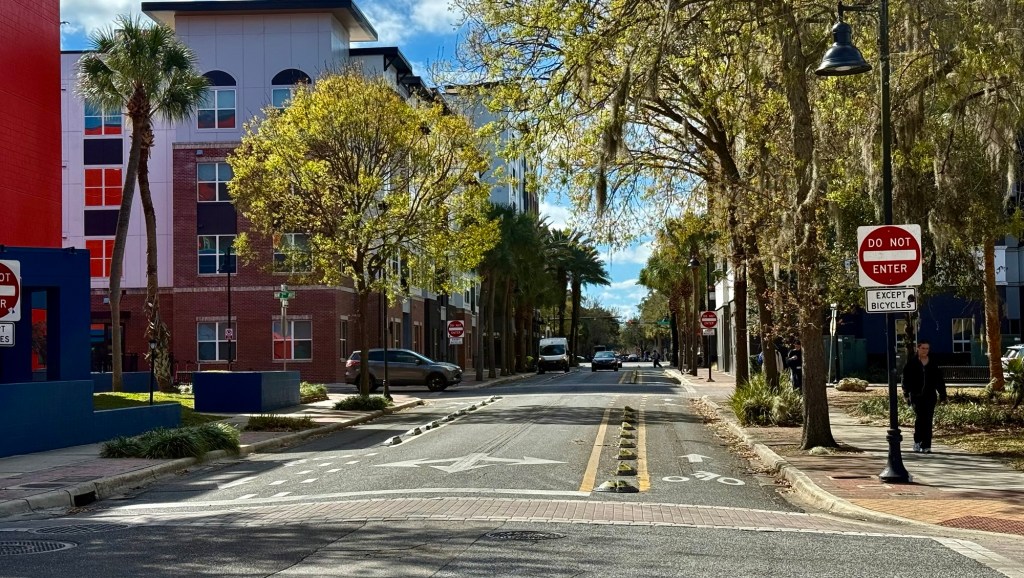
North of University, the City has turned 17th into a single, one-way traffic lane headed north away from campus. On either side of the that single lane cyclists and pedestrians alike are protected by low “zippers” intended to keep moving cars from straying into places where unprotected people may be be moving hither and yon.
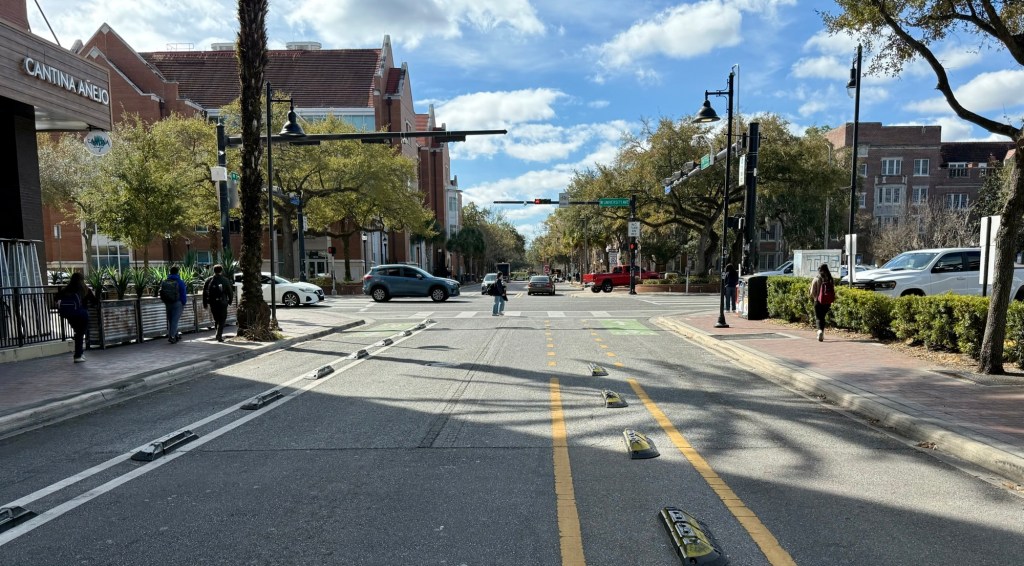
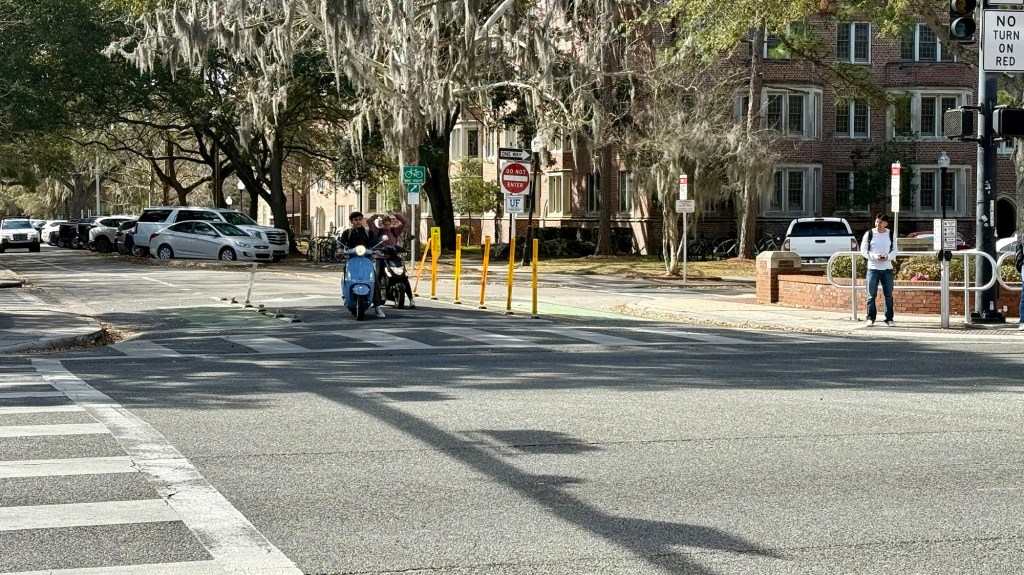
On the other hand, South of University, Buckman is still pretty much an auto-centric corridor where that UF student was injured.
No zippers, bollards or such to protect walkers or cyclists. Bike lanes that can barely be recognized due to fading paint.
And two-way traffic lanes which give the impression that the main function of Buckman drive is to facilitate the efficient movement of automobiles on campus in the morning and off campus in the afternoon.
Which might be fine if there weren’t thousands of students in the mix – constantly crossing University at that point to get on or off campus.
If what GNV does is Traffic Calming 101, then UF’s approach seems to be Whatever Works.
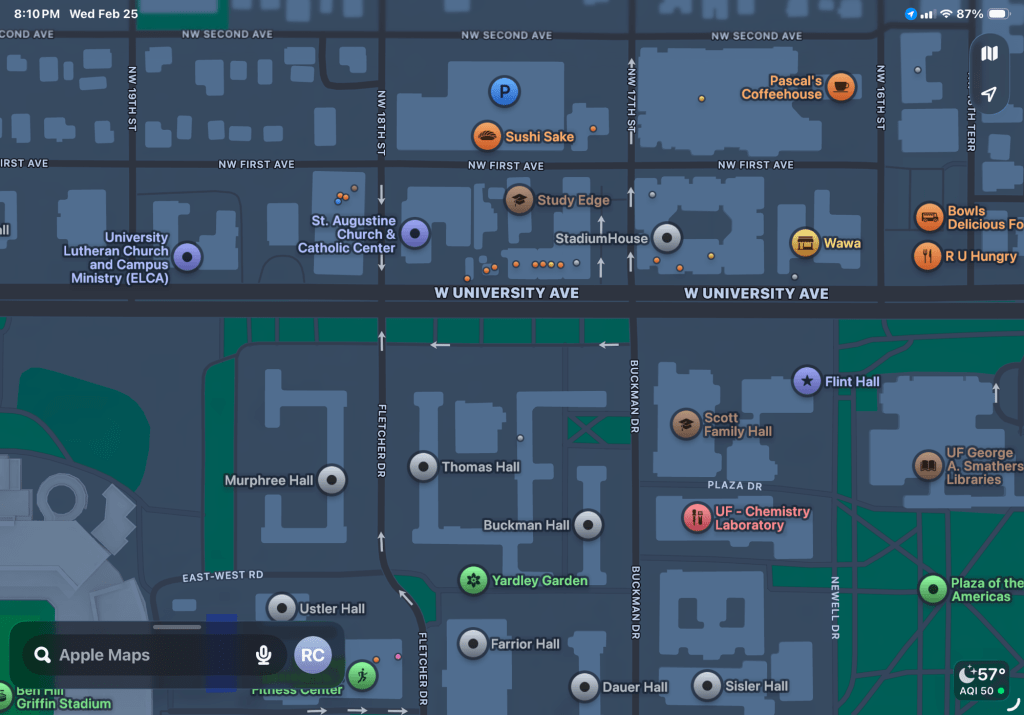
The Town-Gown Design Schism is only further apparent one block west, where NW 18th St. (Town) meets Fletcher Dr. (Gown).
NW 18th completes the City’s “one-way pairing” of traffic flow to and from campus. On 17th, cars in a single lane move south. On 18th, they move north.
Like 17th, 18th street also has designated bike lanes protected by zippers in order to separate human beings from rolling machines.
But Fletcher Dr.? Well, that’s a different story.
On Fletcher, cars north and thus unable to proceed unto NW 18th. They must either turn east or west on University.
One might imagine that it would make sense for Town and Gown to come together in common purpose where 17th and 18th meet Buckman and Fletcher.
If UF were to extend GNV’s one-way pair design onto campus – moving cars from Fletcher to Stadium Road to Buckman, it would seem to make for a more more rational, seamless flow of traffic and people headed on or off campus.
Call it a Town-Gown partnership for public safety.
Unfortunately, a Town-Gown partnership for public safety seems to be lacking these days. And that’s a loss for both Town and Gown.

 FreeGNV