

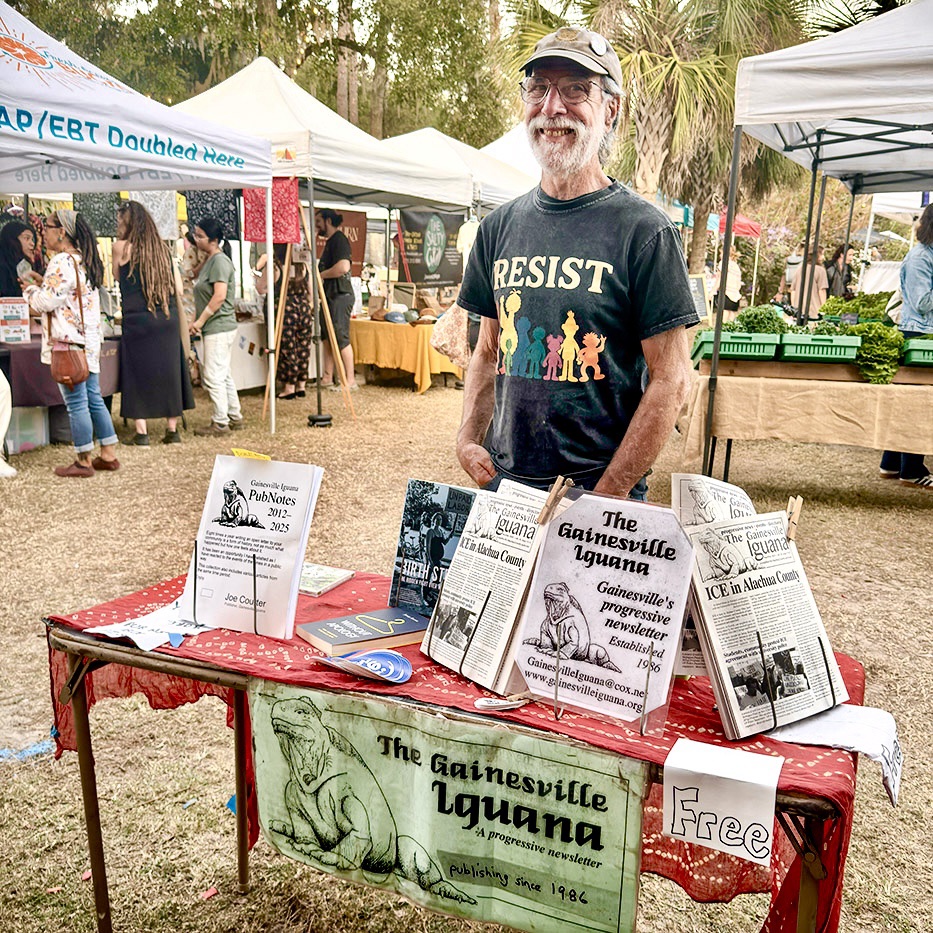
I wrote this profile of Joe for The Gainesville Sun.
They were in an old pickup truck on a New Jersey road, 15-year old Joe Courter sandwiched between his uncle and his father, when the news came over the radio.
Malcom X had just been assassinated.
His uncle said “Good.”
His father said “Ughh!”
And young Joe said “Woah, big!”
Years later Courter would reflect on that moment. “You know, I just paid attention from there.” Watching civil rights demonstrations on TV “when kids were being hit with fire hoses in the South, I thought, they’re my age, right?”
Six decades later, and many miles removed from that New Jersey country road, Joe Courter is having a Gainesville moment.
Author and Grand Marshall
Today, Dec. 6, he is signing copies of his new book at The Lynx’s Local Author Festival.
On Jan. 3 he will be the grand Marshall of the third annual Flying Pig parade.
“We chose Joe because he’s done good things for our community for years, and, because everybody loves him,” said Flying Pig organizer Glenn Terry. “What’s not to love about a plain, humble man spreading the truth?”
Oh, and as 2026 dawns, Courter will begin his 40th year publishing The Gainesville Iguana. The city’s enduring “soap box for Alachua County activists.”
Wait! The Iguana? In a town that worship’s all things Gator? How’d that happen?
It didn’t happen overnight, that’s for sure.
Courter’s 1975 arrival in Gainesville, from Colorado, was something of a lark. A friend promised him a job and a place to crash. But he knew virtually nothing about the town.
Even so, it didn’t take Courter long to embed himself in Gainesville’s music scene and activist community.
A neighbor, Alton Foss, was one of the acquitted defendants of the Gainesville Eight conspiracy trial. And Courter soon hooked up with the Vietnam Veterans Against The War.
Demonstrations, music and volleyball
As Courter recounts in his new book “Gainesville Iguana: PubNotes 2012-2025”: In this southern college town he found “anti-war activists, feminists organizers, environmentalists, activists in local government and all the musicians and music venues.”
And not to forget “a great group of friends who played volleyball every Sunday.”
“I was home, and things just sprang from there.”
As for The Iguana, Courter’s four-decade old labor of love had its genesis in two local newsletters he was editing – one for the Committee In Support of the People of Latin America, and one for the Humanist Society of Gainesville.
Gainesville Quakers also had a newsletter. “We merged and purged those lists,” he recalled, “and thus was born the Gainesville Iguana as a mailed out monthly newsletter” in 1986.
The first Iguanas arrived in the form of photo-copied mail-outs. “But then we realized that newsprint was incredibly cheaper,” said Jenny Brown, Iguana co-founder, Courter’s former wife and still collaborator. “And there is something about paper that attracts people, even in the internet age. You’re standing in line, see a free Iguana, and read it while you’re waiting.”
As to how Gainesville’s feisty paper got its name, because of one former newsletter’s connection to Latin America, Courter said, “my mind just immediately clicked to Iguana.”
The Alligator having already been taken, “we chose an alternative lizard. And it was alliterative.”
No question the alliterative Iguana has stood the test of time.
Pure advocacy journalism
Regular readers of the mini-tabloid sized newspaper know exactly what to expect. And Courter makes no apologies for publishing a newspaper packed with pure advocacy journalism rather than standard who, what, when, where and why reportage.

Here’s a sample of headlines in the latest issue.
Get ICE out of the swamp!
Dick Cheney is dead: Trump is his monster
Florida’s black bears need your voice
The human costs of worker neglect
Virtually all those articles contributed by advocacy groups that are involved in the issues being written about.
And, of course, each edition contains Courter’s own “pub notes.” The latest of which is headlined “Being Woke and the Holidays.”
“Hang in there, keep hope alive, stay healthy,” his final pub note of the year counsels. “We each get one life, don’t let them steal your joy.”
What drives Courter to keep laboring away on a free, call to action, newspaper? Year after year? Decade after decade?
“I call it paying rent on the planet, that’s what I do,” he said. “Living in a democracy is meaningless without participation. We all need to do something to make the world better.”
And lest you think that four decades putting out The Iguana has made Courter the Rupert Murdoch of Gainesville publishing, think again.

He’s proud of the fact that The Iguana is entirely volunteer-driven, his own labor included. The paper strives to make just enough in ad revenues to cover the cost of printing.
As for Courter, he drives a ‘95 Dodge Caravan, a hand-me-down from his mother-in-law. It’s got 270,000 miles on it.
And a bumper sticker that says “Tax The Rich.”
“I’ve worked odd jobs,” he said. “A house painter, a handyman. I’ve always lived pretty cheap. I’m not a material person.”
Nor is The Iguana Courter’s only contribution to Gainesville activism. He was one of the founders of the Civic Media Center – since 1993 a Gainesville counter culture news archive, meeting center and event venue.
“We felt like it was really important to have a place where alternative media could be found,” he said. “We needed a repository for all the information out there. And it’s also a cultural place as far as music goes.”
Making his mark in GNV
Courter also had a hand in launching the Alachua County Labor Coalition, a still active organization “committed to the economic, environmental, civil, and social rights of working people, their families, and communities, and to the ecological systems that sustain us.”
“Jenny and I and a few other people started that in the ‘90s” to help promote a non-binding referendum for single payer health care. Over the years “the Labor Coalition has really grown into a great activism organization.”
If you have been around Gainesville long enough, chances are you have probably already met and interacted with Courter.
You will find him every Monday afternoon handing out Iguanas at the Grove Street Farmers Market. His is a familiar face during Fest and Tom Petty weekends and at any number of local music halls.
If there is a Gainesville “No Kings,” or “Hands Off” demonstration, Courter is there brandishing the appropriate sign. And he frequently makes citizen comments at Gainesville and Alachua County public meetings.
“There’s something Pete Seeger used to say about just going into a community and making things better there,” said Brown. “Joe is the best example I know of that. He knows who the people are and he tries to help them stitch together something really special. Walk around town with him and he seems to try to stop and talk to everyone we meet.”
The unofficial mayor of GNV
“He’s the unofficial mayor of Gainesville in a way.”
Gainesville’s official mayor, Harvey Ward, may take issue with that. But even Ward understands that Courtier is something of a Gainesville institution.
“Joe Courter is an essential, and quintessential, example of what makes Gainesville Gainesville,” Ward says. “He has an abiding conviction to justice combined with a thoroughly pragmatic understanding of how our community and its government function.”
Courter, Ward added, “has provided a working model of effective activism and advocacy to generations of Gainesvillagers.”
All of which would seem to make Joe Courter a ‘Gainesvillager’ of the first order.

 FreeGNV