


Run away! Run away! Oh, never mind
Further proof that the University of Florida is still far too woke for this here Free State Of Floriduh.
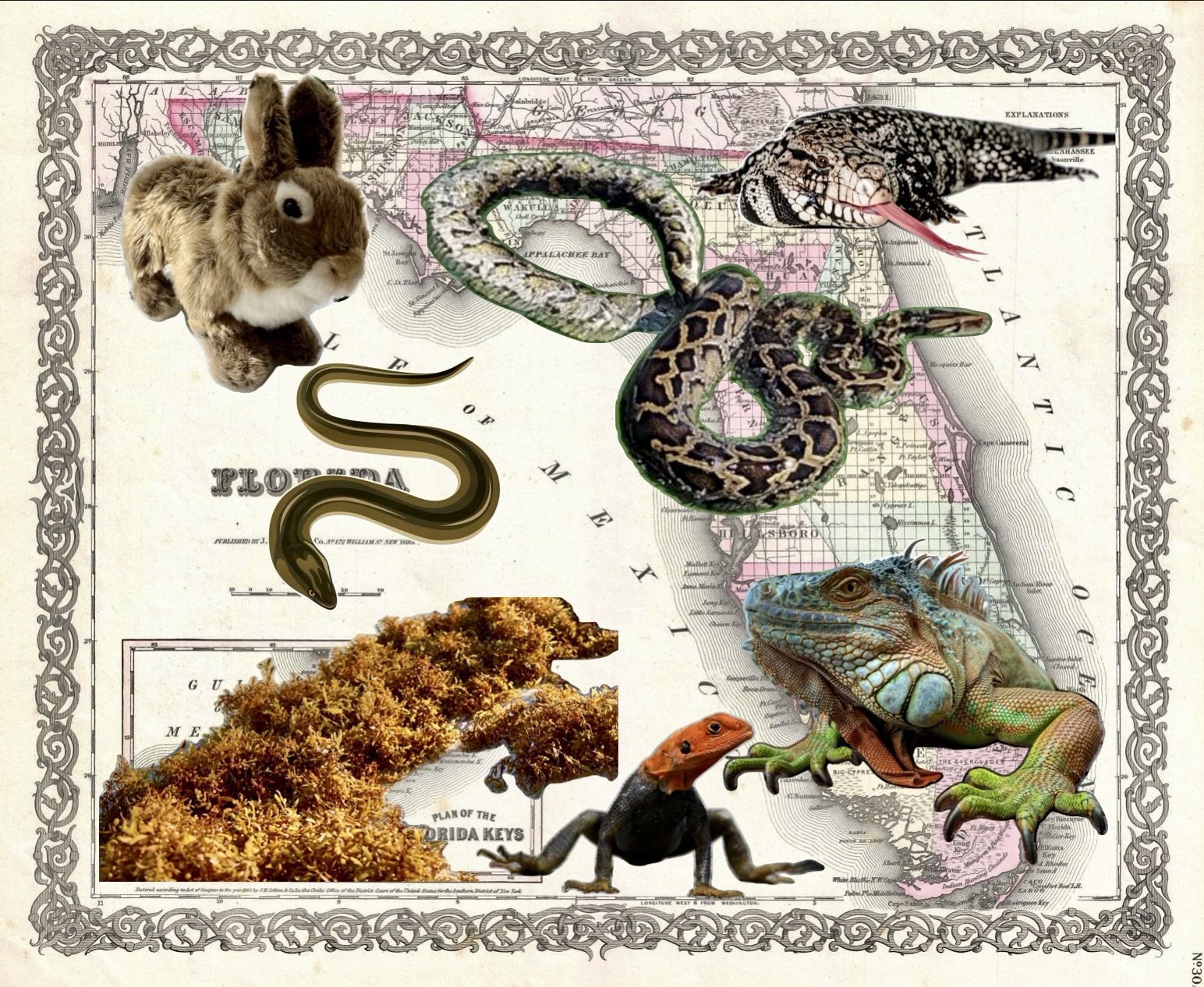
Turns out that UF scientists have deployed 40 furry little robo-bunnies to help in efforts to, um, flush out the Burmese Pythons that have made themselves to home in the Everglades.
So what’s wrong with that? Well, the robo-bunnies won’t explode when jaw-snatched. They don’t shoot lasers out of their beady little eyes. They don’t even go for the throat like Monty Python’s infamous killer bunny. (‘Run away!’)
In a state whose official new motto is ‘The Cruelty Is The Point’ (only in Latin) leave it to GNV eggheads to deploy pacifist rodents.
Bon appetit
Speaking of our sinuous Burmese imports, now that the state’s annual python hunt is underway, here’s an important and timely public health notice: Catch as many of ‘em as you like…but whatever you do don’t eat them!
The Florida Department of Health has issued a “Do Not Consume Python” advisory for Burmese pythons because of the high levels of mercury found in their meat.
That’s right, Floriduh pollution is poisoning our, um, tourist pythons.
Oh, and one more thing
Turns out our invasive snake problem is getting even more complicated because scientists are detecting a new breed of Burmese and Indian python hybrids. According to the U.S. Geological Survey this interbreeding “can lead to hybrid vigor, that is, the best traits of two species are passed onto their offspring…an invasive population like the Burmese pythons in South Florida, this could result in a broader or more rapid distribution.”
Can’t say we haven’t been warned. Neocons have been harping about the Great Replacement Theory for years. Turns out reptiles are just ahead of the GRT curve.
Micro-killer update
But enough about pythons, here’s some good news for a change: Only 4 people have died in Florida this year from flesh-eating bacteria – so far.
FEB is most commonly contracted by eating shellfish or wading into brackish seawater with open wounds. We gotta call it good news because last year 11 people died from exposure to the tiny micro-killers.
Course, we’re just over halfway through the year.
Quick and dirty roundup
In other Invasive State news:
Sargassum sea weed levels washing up on Florida beaches are at a record high this year according to the University of South Florida’s Sargassum Watch System. April alone experienced a record-breaking amount of sargassum, exceeding previous high levels by 40%.
Good for marine life, terrible for tourists.
Listen, cold-stupefied iguanas won’t start dropping out of south Floriduh trees for several months yet. But when they do, be advised: They make a tasty soup. And a passable pie.
As if invasive pythons and iguanas aren’t bad enough, now comes the Asian Swamp Eel to add to the exotic fun. According to UF scientists these slippery little fellows can ”thrive in a variety of aquatic environments,” are “opportunistic feeders,” and are likely to “disrupt food webs and harm native biodiversity? Other than that, no problem.
Oh yeah, and then there’ the Peter’s rock agama, strange looking orange lizards that like to feast on native insects and lizards. Not to worry though, we’ve got lots and lots of native insects and lizards to go around. I think.
Plus, I would be remiss if I didn’t mention the Argentine tegu. As per the state Fish and Wildlife Commission “ Potential impacts of tegus include competition with and preying upon Florida’s native wildlife, including some imperiled and protected species. Tegus prey upon the nests of other animals, and researchers have documented tegus eating American alligator eggs and disturbing American crocodile nests in Florida.”
But to be fair, who doesn’t like a tasty American alligator egg?
Listen, we’ve gotten so used to attracting invasives from around the globe that we’re even starting to predict which uninvited and unwanted species will be next to move here: Perhaps the spotted lanternfly.
“Also known as spot clothing wax cicada or the spotted wax cicada, this native of China was discovered in Pennsylvania in 2014 and has since spread to 17 states…,”reports the Gainesville Sun. “Although it hasn’t been spotted in Florida, the Sunshine State does have one of its favorite foods — the tree of heaven… The insect…feeds on woody and ornamental trees as well as a wide variety of crops and plants, including peach and nectarine trees?”
And finally, least but not last: Meet the conehead termite. (And no, I am not making this up.) Native to the Caribbean and South America this little, um, bugger has been detected in the U.S. for the first time ever.
Guess where? That one’s a no brainer.
“Coneheads can wreak havoc on structures and landscapes, causing extensive damage,” reports the Florida Department of Agriculture.
“They eagerly consume dead wood from live or dead trees, shrubs, grasses, roots, wood in structures and furniture, and cardboard and other paper products.”
Sounds grim. But with any luck at all ravenous Peter’s rock agama will nibble ‘em all up before buildings and trees start to collapse the length and breadth of the Invasive State.
Listen, it’s what I’ve always said about Florida: Whatever you don’t eat is likely to eat you.

 FreeGNV