


I wrote this piece for publication in The Sun
When Santa Fe College student Saoud Al-Ammari, Qatar native and a gay man, lost his visa, he feared deportation back to his repressive native county.
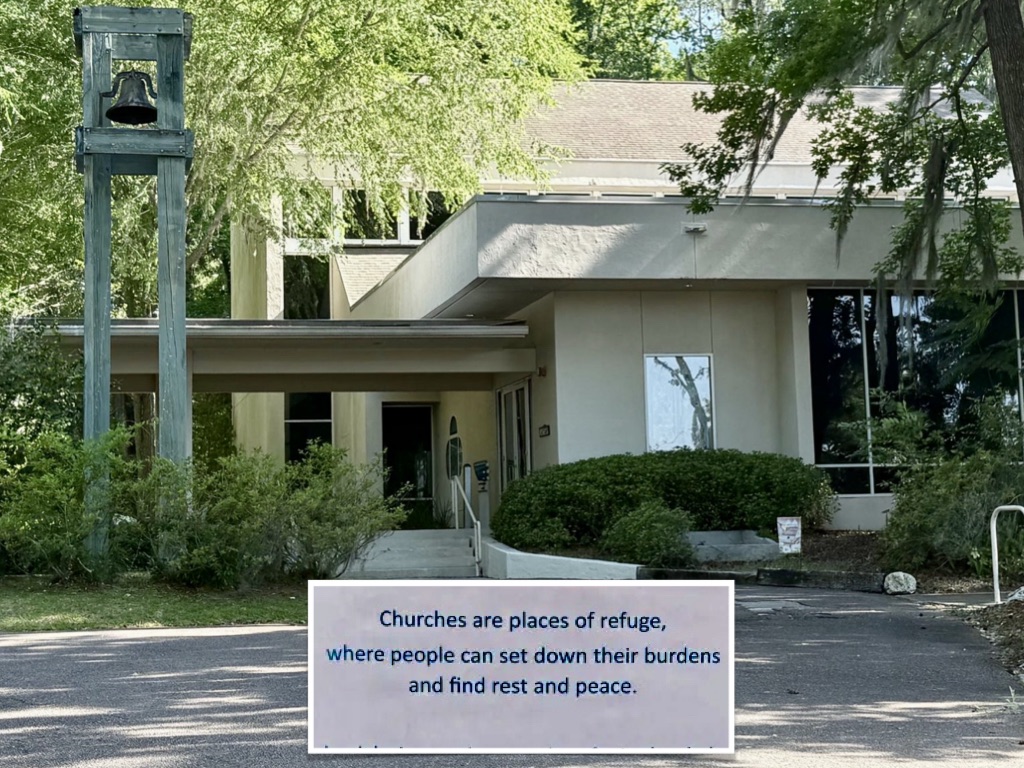
To avoid arrest, he took up residence at Westminster Presbyterian Church in Gainesville.
Westminster was the first Gainesville church to declare itself a sanctuary. To help Al-Amari, Rev. Larry Green, then church pastor, told The Sun in 2019, “we created a living space: a bedroom, bathroom, kitchen. We provide his food’ and provided other assistance.
Al-Amari lived at Westminster for about a year before being granted legal asylum status. “We were very happy for him,” said Rev. Rebecca Putman, current pastor of the church.
Six years later Westminster Presbyterian is stepping up its activism on behalf of migrants. This time on a national scale and in a courtroom on the other side of the country.
The church is one of a handful of plaintiffs that have filed suit in the U.S. District Court in Portland, Oregon challenging the right of the Trump Administration to send ICE agents into schools, churches, health care clinics and other “sacred spaces” in search of illegal immigrants.
“What drew us to this lawsuit in particular was the scope of it,” Putman said. “This is not just about Gainesville, it is about something that is happening nationally.
The church’s participation in the litigation came about almost by serendipity after Putman met attorney Tess Hellgren at a gathering of the Gainesville Immigrant Neighbor Inclusion Initiative.
Although she lives in Gainesville, Hellgren is director of legal advocacy for the Innovation Law Lab, a Portland-based nonprofit that uses legal advocacy and technology to advocate for immigrant justice.
“It is incredibly meaningful to be able to represent a local church that’s doing this incredible work” on behalf of undocumented immigrants, Hellgren said.
In addition to Westminster, plaintiffs include PCUN, Oregon’s largest farmworker advocacy group; Augustana Lutheran Church, in Portland; Our Lady of Guadalupe, in San Diego; and the San Francisco Interfaith Council.
The litigation argues that for decades, under both Democratic and Republican administrations, there has been an understanding that immigration officials should avoid going into churches, health care clinics, schools and the like except in extreme cases, for instance, when terrorism or violent crime is involved.
The Trump Administration’s decision to no longer respect such spaces violates the First Amendment, the Religious Freedom Restoration Act, and the Administrative Procedure Act the litigation states.
“Civic gatherings, houses of worship, schools, and health clinics should be places for adults and children to assemble, celebrate, worship, learn, and heal—not zones for deportation enforcement,” the lawsuit asserts. “As a result of the administration’s new policy, sacred spaces have become sources of extreme anxiety rather than places of healing, expression, reflection, celebration, and refuge.”
After the litigation was filed, the Department of Homeland Security issued a statement saying that the policy change “gives our law enforcement the ability to do their jobs.”
But it added: “For context: Our agents use discretion. Officers would need secondary supervisor approval before any action can be taken in locations such as a church or a school. We expect these to be extremely rare.”
The litigation repeatedly uses the term “sacred spaces,” to describe churches, schools, health care clinics and related places.
“We use that term intentionally,” said Hellgren, “because we want to convey what it means to have these types of locations protected for all. We should be able to send our kids to school and feel safe doing so. You should be able to worship without fear.
“At a time when there is a lot of rhetoric that seeks to divide us, these spaces are, and should remain, places where people can come together…that’s what this case is really fighting for.”
Although Westminster is not currently offering sanctuary, Putman said the church provides other programs to assist undocumented migrants. For instance, it partners with local nonprofits to conduct “Know your rights” workshops.
She worries that the fear of being confronted by law enforcement will have the effect of discouraging undocumented immigrants from coming to the church for help.
“We haven’t completely dismissed the idea of taking someone into sanctuary on our campus, but it would have to be something very different than it’s been in the past,” Putman said.
As for the litigation, she said “what I would like to see happen is for the lawsuit to succeed for these sensitive locations. I love the narrative use of ‘sacred’ because these are places that I think define what it means to be human, to be able to be healed, to learn, to grow and have spiritual support.
“You know, for our religious beliefs, being able to offer welcome and sanctuary is paramount. Participating in this lawsuit is part of how we are trying to preserve the truth that human lives are sacred. Part of our faith is speaking truth to power.”

 FreeGNV