


Buddy MacKay has died at the age of 91. Here’s a piece I wrote for The Sun several years ago about how Buddy and other Florida vets came home and transformed their state.
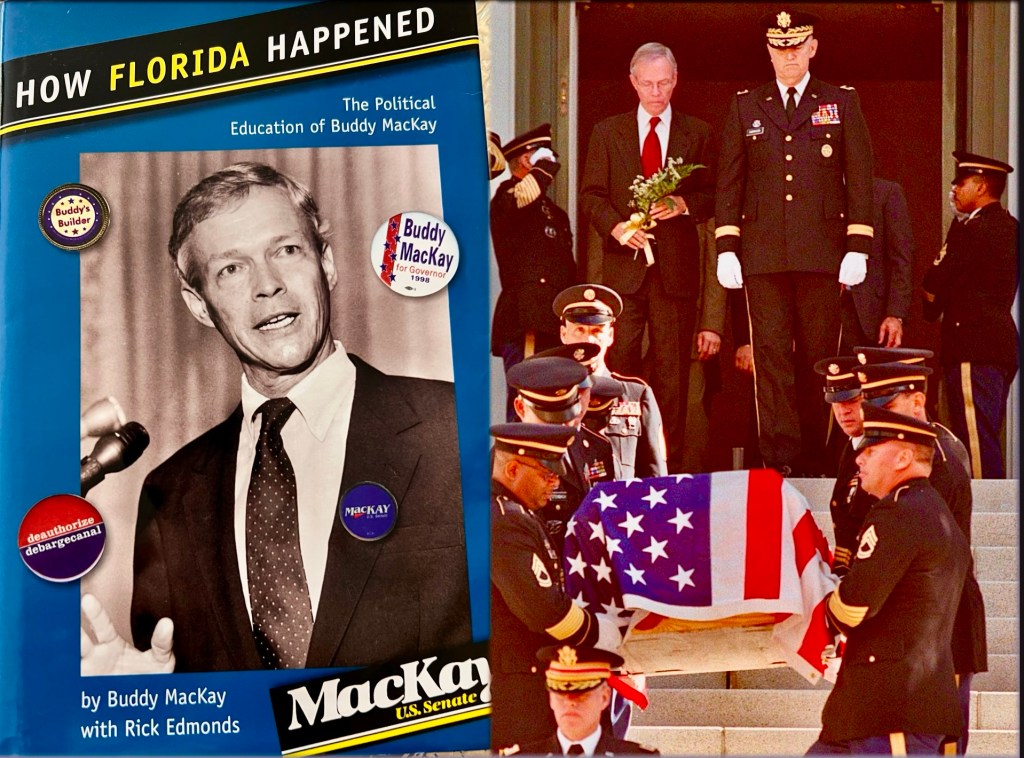
Right: MacKay’s book, How Florida Happened. Left, MacKay walks with the honor guard at Gov. Lawton Chiles’ funeral.
At 19, I burned my draft card to protest the Vietnam War.
I did it over a beer the night before I shipped out for boot camp.
Then, I spent four years on a U.S. Navy destroyer. Saw the world. Lived in close quarters with about 150 guys in an environment where the failure of just one sailor to do his job could have catastrophic consequences.
And returned a changed man.
I only mention it because the other night I went to UF’s Graham Center to listen to former Gov. Buddy MacKay talk about his life in Florida politics. Somebody asked him how he got into politics to begin with. And Buddy’s answer surprised me a bit, although it shouldn’t have.
The Ocala native said he joined the Air Force, experienced life in an integrated society for the first time and saw and did some things that opened his eyes.
And then he came home to find that Florida had not changed one wit in his absence.
“I was embarrassed,” he said.
It may seem hard to believe, but there was a time, albeit briefly, when Florida’s legislature was deemed one of the most progressive in America.
MacKay calls it the “Golden Age,” when Florida finally got over Reconstruction and grew up.
In his new book, “How Florida Happened,” MacKay writes “the political maturity to make those difficult changes in the 1960s and 1970s came out of the common experience of young men in World War II and the Korean War.”
Veterans, in other words.
MacKay’s generation may have been the last in which military service was the rule rather than the exception, thanks mostly to the draft. Now, veterans are rarer than liberals in American politics.
Does that matter? It might. And not just because combat can be life-altering; many vets never experience combat.
No, it’s because the military plucks you out of your comfort zone, plops you down in places you never imagined you’d be, surrounds you with people who may not look, act, talk or think like you do and then tells you to get on with it and do your job.
And then it sends you home, where, like MacKay, you just might end up being embarrassed by a social or political status quo that never much bothered you before.
In his speech at Duke University this week, Defense Secretary Robert Gates urged college students to consider joining the military to take advantage of “the opportunity to be given extraordinary responsibility.”
“Our young military leaders in Iraq and Afghanistan have to one degree or another found themselves dealing with development, governance, agriculture, health and diplomacy,” Gates said. “And they’ve done all this at an age when many peers are reading spreadsheets and making photocopies.”
All in all, not bad basic training for coming home with a mind to change what embarrasses you about American life and politics.
Perhaps this new generation of vets will do just that.

 FreeGNV
I was 3 years too old to be drafted for duty in the unnecessary stupid disasters of Vietnam, so I went to college, then to Grad school in Hawaii. We heard many hundreds of jets overhead for 5 years carrying innocent Americans to Vietnam. I then had a 37-year quite adequate, proudful career in Science. I didn’t know then and don’t know now, much any Brass, just many worthy grunts, of which maybe 5% would vote for D.Trump. Few of my present compatriots have dealt in US policies, and apparently even fewer in elective politics. But they all learned well that in the Armed Forces you have to deal with a lot of crap, but NOT DELIBERATE LIES, as that would cause incredibly deadly outcomes. Now we hear continuous, complete lies as official political statements. Incredible. Look down at the dirt, Shake your head, Here in my wonderful America.