


Gov. Ron DeSantis cites historical “precedent” to dismiss climate change. His reasoning: Florida has always had hurricanes and always will have hurricanes.
Here are a couple of precedents that seem relevant.
To free up vast expanses of “fabulous muck” for farming, Gov. Napoleon Bonaparte Broward began to drain the Everglades.
And after hurricanes killed thousands, the U.S. Army Corps of Engineers built a dike around Lake Okeechobee to render its shores safe for human habitation.
Both projects – carried out at enormous public expense – did what they were intended to do. Agriculture is a huge South Florida industry, and farms, towns and suburbs took root on one-time Okeechobee flood plains.
But both of those projects, inevitably, have had costly negative consequences that continue to haunt us today.
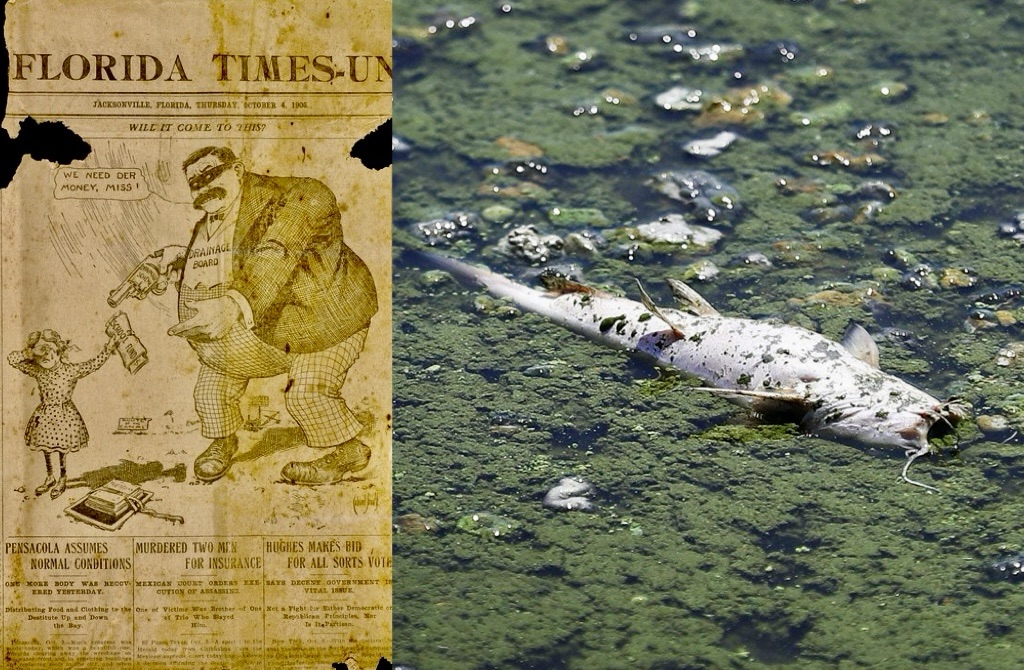
Broward’s folly forever interrupted the natural flow of Florida’s River Of Grass, creating so many water quality and quantity problems that billions of dollars are still being spent on ‘Glades restoration.
And The Herbert Hoover Dike turned Okeechobee into an algae-clogged cesspool, whose tainted waters must periodically be released – lest the levees burst – into rivers that carry its pollution toward both coasts.
I bring up these precedents to point out the fallacy of DeSantis’ insistence that it is not government’s role to restrict coastal development.
This after hurricanes Helene and Milton – supercharged by increasingly warmer gulf waters – destroyed or damaged countless homes, condos and businesses up and down the west coast.

DeSantis told reporters “people work their whole lives and work hard to be able to live in environments that are really, really nice, and they have a right to make those decisions with their property as they see fit.”
The problem is that the ability of individuals to exercise their private property rights the length and breath of Florida’s fragile coasts could not exist without the backing of vast taxpayer subsidies.
How do all taxpayers help prop up coastal private property rights?
Start with the enormous costs of rebuilding roads, bridges, sewer systems and the like each time a tempest devastates a seaside community. Just rebuilding the Sanibel Causeway after Hurricane Ian cost taxpayers more than $23 million.
And there is a reason state-owned Citizens went from being the “insurer of last resort” to Florida’s largest insurer. Most private insurers are unwilling, or unable, to cover the inherent risks.
Similarly, there is a reason the federal government is America’s major provider of flood insurance. Most private companies won’t do it.
Pro Publica, the non-profit investigative news service, shows how federal tax dollars subsidize coastal private property rights in at least four ways.
1. The U.S. Army Corps of Engineers spends billions to “reseed” beaches. This to prevent homes, condos and businesses from washing away along with the sand that used to protect their foundations.
2. The Stafford Act “commits the federal government to paying 75 percent of the cost of rebuilding roads, bridges and other infrastructure damaged in a disaster.” In just one example, the federal government has since 1979 spent at least $800 million to rebuild Alabama’s Dauphin Island. “That’s more than $60,000 on each of the community’s 1,300 residents, adjusted for inflation.”
3. National Flood Insurance premiums are about half the true market risk rates. As a result “there is more development near water than there would be under a totally private market,” Eli Lehrer, of the conservative think tank R Street Institute told Pro Publica.
4. And, finally, generous federal tax laws allow owners of storm ravaged properties to deduct expenses not covered by FEMA or insurance.

For all practical purposes, coastal residents could not exercise their private property rights if politicians were not willing to commit enormous public sums to secure those rights.
That’s not to say that coastal hurricane victims should be left to fend for themselves. But a more rational public policy would at least demand that people who choose to build on a shoreline assume more personal responsibility for the risks.
Climate scientists have long advocated a policy of gradual retreat away from the coast. That might be accomplished – in perhaps a few generations – if each time a coastal property is destroyed, government offered its owners fair compensation – on the condition that they move inland.
And those who choose to remain should be required to rebuild according to strictest standards.
In the long run, buying up coastal properties would be cheaper than paying to rebuild again and again and again.

We are all still paying today for Gov. Broward’s folly and the impoundment of Lake Okeechobee.
Are those really the sort of historical precedents that modern Florida wants to follow in an era of rising seas and warming waters?

 FreeGNV
Gainesville will probably see growth from more people (like me) moving inland
by all means, spend money in South Florida like Tampa, and screw the poorer areas like cedar key and horseshoe Beach. I can really imagine if Mara large was damaged.