

The law, in its majestic equality, forbids rich and poor alike to sleep under bridges, to beg in the streets, and to steal their bread. ― Anatole France
Several years ago I happened to be downtown when I saw an ASO patrol car pull up to the Bo Diddley Plaza.
The deputy got out, opened the back door, let out an apparently homeless individual and admonished him to “behave” as he made his way into the plaza.
At the time, Bo Diddley had pretty much been taken over by street people. Which had the city commission in something of a tizzy.
That ASO may have been running what amounted to an Uber service for downtown-bound homeless was no real surprise. Especially in light of the Alachua County’s sanctimonious position regarding the city-county balance of power in dealing with the homeless.
To wit: Getting GNV’s homeless off the streets is the City’s problem. The County’s job is to – sooner or later…to one degree or another – provide some sort of permanent housing for the unhoused.
So far the County’s role seems limited to buying old motels and fencing them off so the homeless can’t get into them until….well, until the County gets around to fixing them up.
Some day.
Don’t look now, but the county-city balance of power may be about to shift dramatically. This thanks to the draconian Get-The-Hell-Off-Our-Sidewalks law just signed by The Great DeSanitizer.
Basically the law, in its majestic equality, makes it illegal for rich as well as poor people to camp/sleep in public places (parks, sidewalks, under bridges and such). And to make sure that cities and counties enforce the law, it allows people and businesses to sue local governments that fail to sweep the homeless out of sight and out of mind.
It also gives cities and counties the option to establish homeless encampments, provided that a specific list of public safety measures and homeless services are provided.
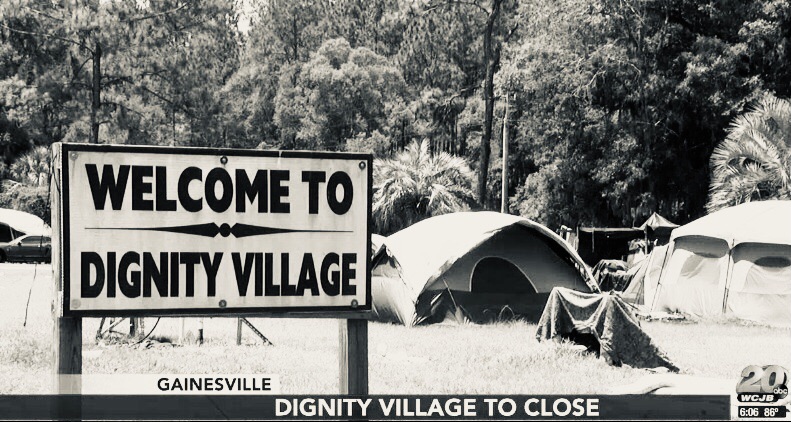
One solution might be a reimagining of Dignity Village . Albeit with more state-mandated policing and social services to avoid the problems that forced GNV to close the original Dignity Village.
The logical place for a new Dignity Village, as the old, would be adjacent to Grace Marketplace. That non-profit already provides the most effective homeless services in this community and, with adequate resources, could conceivably do even more.
But what if GNV and Alachua County commissioners can’t agree to partner on a homeless encampment? What if the county continues to maintain that temporarily sheltering the homeless isn’t its job?
Not a problem.
Alachua County already has what amounts to a default homeless encampment ready and waiting.
The county jail.
Listen, under threat of litigation, Gainesville will have little choice but to arrest people who are illegally sleeping on sidewalks and under bridges.
And what happens when GPD makes an arrest? Police drop off their suspects at the county jail for detention pending trial.
Rather like that ASO deputy who delivered homeless people to the Bo Diddley Plaza.
Remind me again who is responsible for funding the county jail? Oh yeah, the County Commission.
But listen! Correctional facilities are the most expensive, and least effective, way to house the homeless. And especially the large number of homeless people who suffer from mental and physical illnesses.
But that’s not GNV’s problem. It’s not even the State’s problem under the new law.
It’s Alachua County’s problem.
Needless to say, it shouldn’t have to come to that.
Warehousing homeless people for lack of another place to put them is the literal definition of cruel and unusual punishment.
No, in light of these new state mandates GNV and Alachua County should be full partners in a strategic plan to get the homeless off the streets, out from under bridges, and into a safe and supportive environment.
The law goes into effect later this year. City and County commissioners need to get to work right now on a more humane solution.
The Great DeSanitizer has decreed that the rich as well as the poor shall henceforth be prohibited from sleeping on our sidewalks, in our parks and under our bridges.
That’s where we are now. Let’s work with it.

 FreeGNV