

I wrote this piece about the Gainesville 8 50th anniversary reunion for the Gainesville Sun. I’m reprinting it here in my blog.
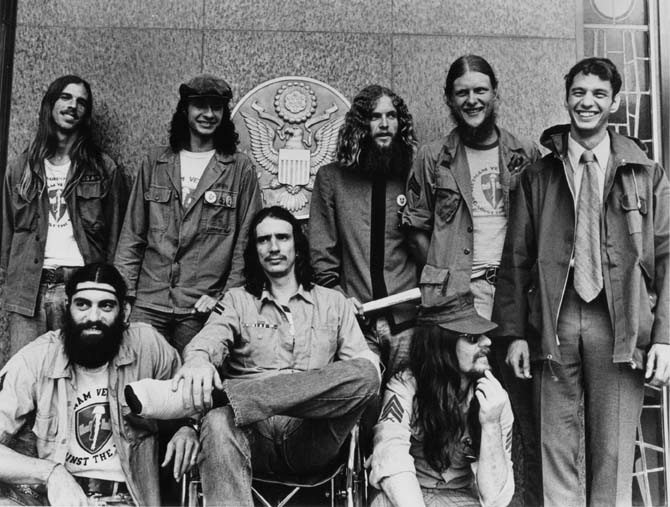
Bottom row left to right: Scott Camil, Alton Foss, John Kniffin.
The last time they gathered on the steps of Gainesville’s federal courthouse, they were eight strong.
Eight young men who erupted in celebration after learning that their jury declined to send them for prison for allegedly plotting to disrupt the 1972 Republican National Convention in Miami Beach.
That was half a century ago.
On Friday, Aug. 25 the five surviving defendants of the 1973 Gainesville Eight trial – one of several Nixon-era conspiracy trials aimed at suppressing anti-war activism – returned for another group photo on the courthouse steps.
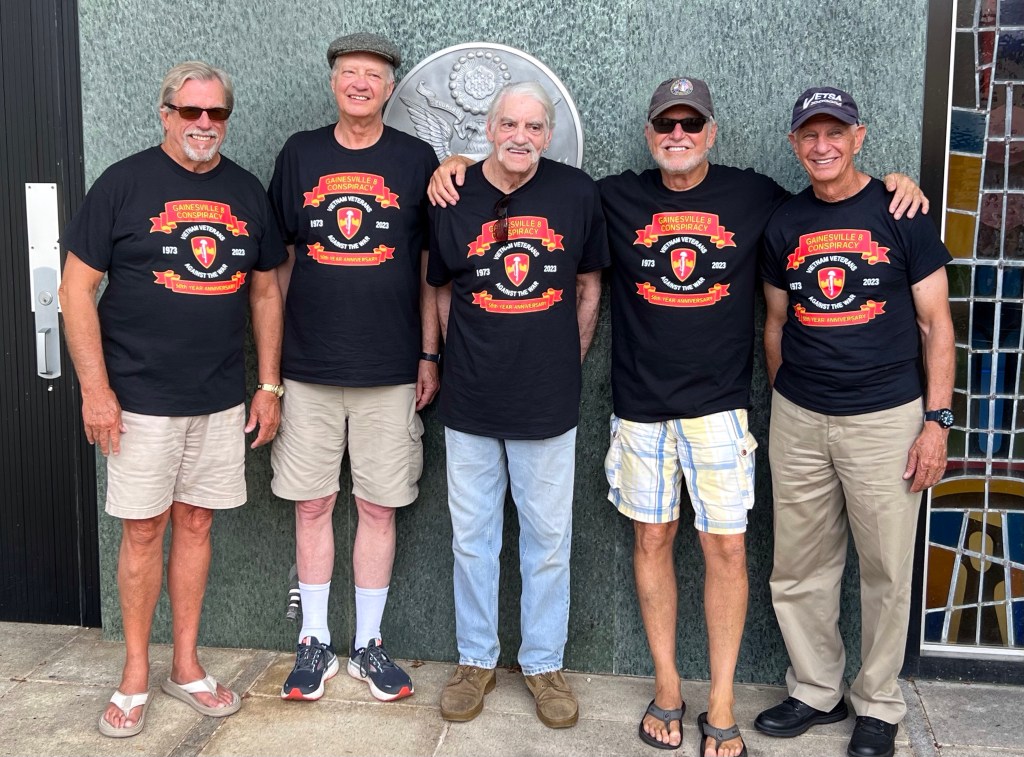
Only this time, instead of facing bailiffs, FBI agents or federal marshals, these now elderly men were welcomed back to Gainesville by Mayor Harvey Ward.
Ward read a proclamation commending them for occupying a “special place in the history of our community and our nation.”
And the mayor declared Thursday, August 31, 2013, to be “Gainesville Eight Day” in the city that lent their trial its name.
“I thought it was important to come back” said 74-year old Don Purdue, a former combat Marine who went on to have a career in emergency response management in Broward County. “Vietnam was an important part of my life,” as was joining the Vietnam Veterans Against The War and subsequently being put on trial. “Looking back, I sometimes wish I had done more” for the cause of peace.

“We are glad you’re here,” Ward told them.
Three of the eight defendants, John Kniffin, William Patterson and Alton Foss have passed away. And certainly the remaining five bear little resemblance to the lean, hirsute, combat hardened defendants who posed in front of the courthouse seal for an iconic photo 50 years ago.
Their hair noticeably thinned and whitened. Jowls a bit heavier perhaps. Weight somewhat, um, redistributed.
But if the flesh is noticeably weaker, the spirit that once compelled them to throw away their medals and take to the streets is still willing.
“I’ve always been me,” said Scott Camil, the longtime Gainesville peace activist and local political campaign organizer who federal prosecutors deemed the ringleader of the accused conspirators. In addition to the Gainesville Eight trial “I’ve had several other trials,” he said. They even shot me once.”
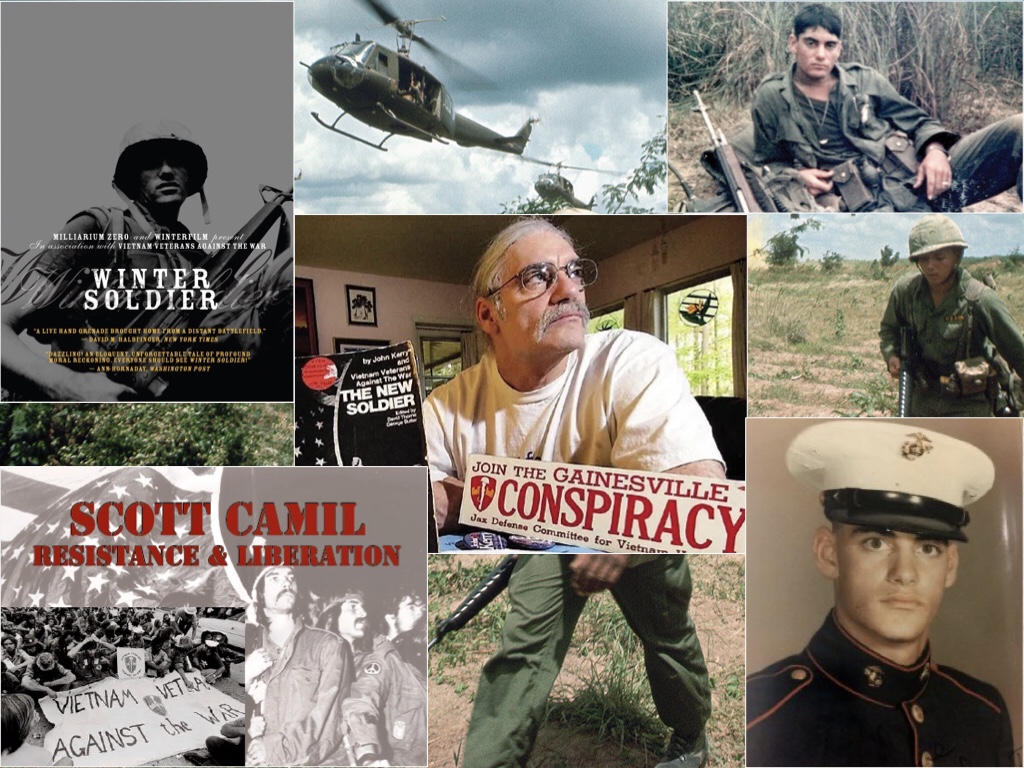
Twice wounded as a marine in Vietnam, Camil was shot in the back in 1975 by DEA agents in a Gainesville sting. Subsequently charged with drug offenses and resisting arrest, Camil was, once again, found not guilty.
Noting the failure of the Justice Department to get guilty verdicts in the Gainesville 8, Chicago 7, Camden 28 and Harrisburg 7 conspiracy trials, Camil mused “I guess that the government was used to intimidating people. Vietnam veterans weren’t the kind of guys you could intimidate. We stood up to them.”
Larry Turner, retired attorney and former circuit court judge, was a junior member of the Gainesville 8 defense team and also represented Camil in his other trials.
“I’m a much better lawyer for having gone through that trial and working with some of the best lawyers in the country,” Turner recalled. “Not many young lawyers had the opportunity to get a good case with a good cause. A case you think can win if you do a good job.”
Beyond that, Turner reflected, having grown up in the Florida Panhandle town of Marianna, and as a still freshly-minted lawyer, getting drawn into the Gainesville Eight trial was an eye-opening experience.
Federal prosecutors mostly relied in the suspect testimony of informers for lack of hard evidence. And at one point two FBI agents with wire tapping equipment were discovered in a broom closet next to the defense conference room.
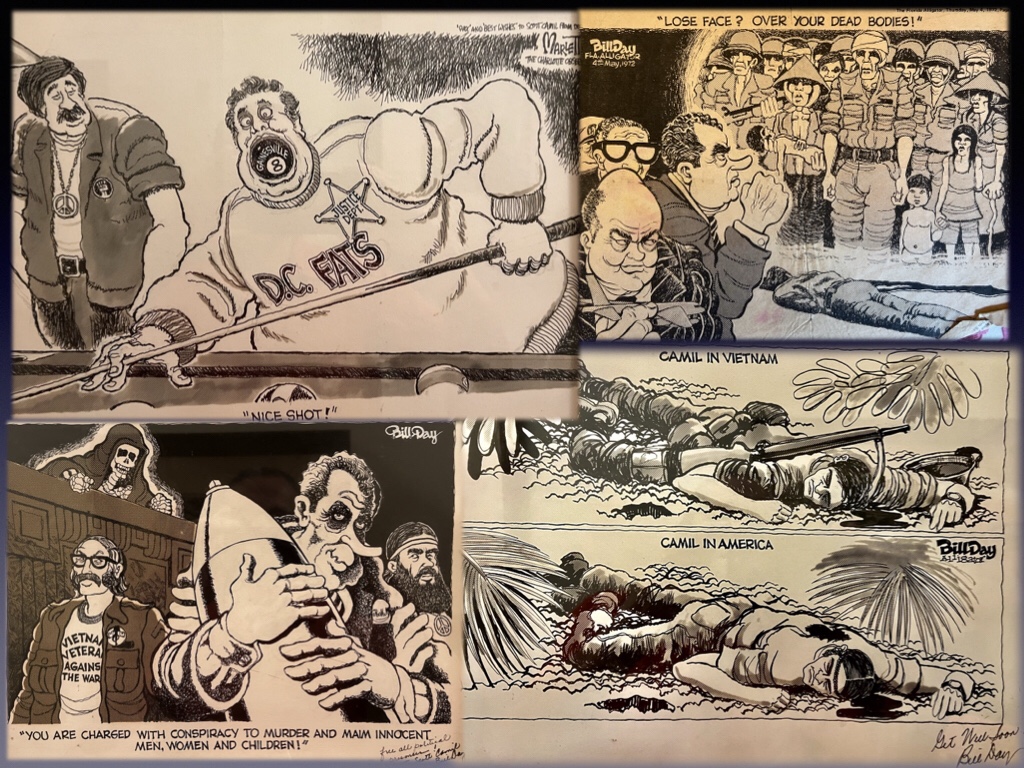
“I saw all the stuff the government was doing and at first I just refused to believe it,” Turner said. “It radicalized me. It certainly made me swing hard left” politically.
Of the five surviving defendants, only Camil would go on to spend his life as an activist continuing to oppose his country’s involvement in war after war, decade after decade.
John Briggs, 71, was the only non-veteran Gainesville 8 defendant. The Gainesville water bed store owner was accused of providing the VVAW members with wrist-mounted slingshots with which to disrupt the ‘72 GOP convention.
Having returned to Gainesville after living elsewhere in Florida for several years, Briggs is now a regional distributor of musical instruments.
Looking back Briggs said it was “a valuable experience watching the justice system work the way it’s supposed to. During the prosecution’s case it became pretty clear to me that the jury was not buying it.”
Indeed, after a weeks-long trial, the jury took just four hours to render a verdict. While they waited, the Gainesville Eight defendants were outside playing touch football.
Peter Mahoney, 75, is retired and living in Vermont. The former infantry lieutenant said “I ended up living a relatively normal middle class life…two kids…the suburbs. But I have never lost my complete distrust of government…never believing a word they said, especially when it relates to war.”
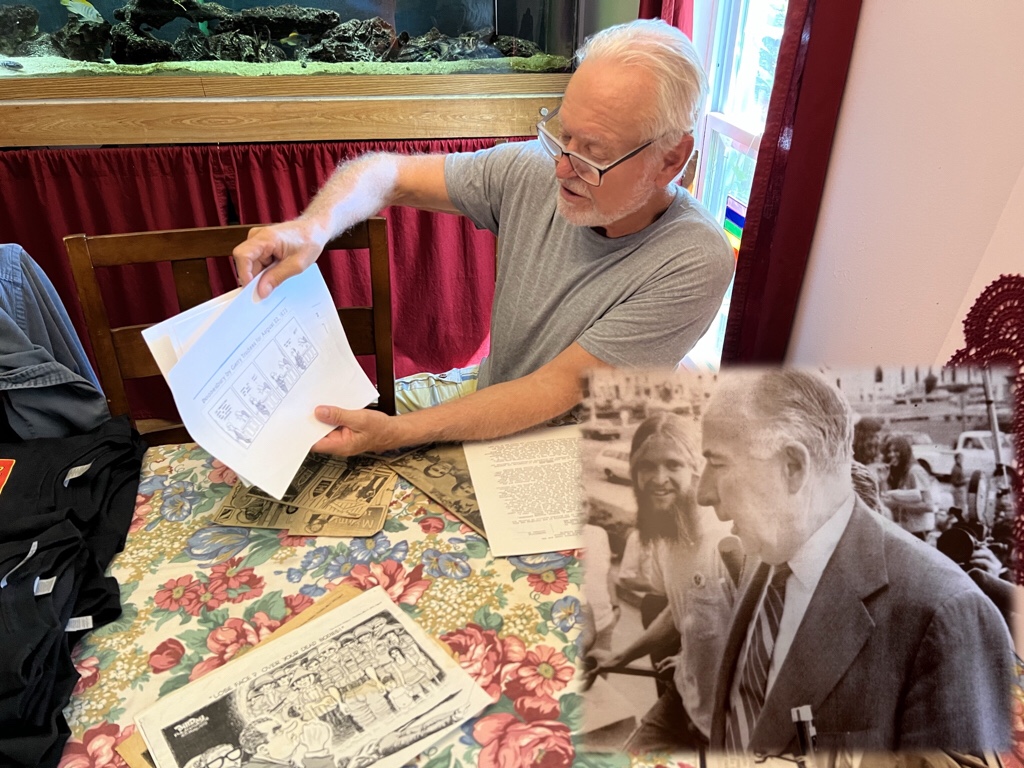
Stanley Michelsen worked a series of jobs before retiring to North Carolina and turning to writing. He recalls living in South Florida after returning from Vietnam and reading about Scott Camil in the newspapers. “I went straight to Gainesville” and told Camil “I’m with you, brother, what do you need from me?”
“Nixon and the rest of them could say whatever they wanted to about the hippies. But they couldn’t say the same thing about us,” Michelsen said. “We fought in Vietnam and we knew what we were talking about. We had credibility.”
John Chambers was not a Gainesville Eight defendant, but he spent more time in jail than they did because he was held in contempt for refusing to cooperate with the grand jury. Now 75, Chambers lives simply on four acres of land in Hawthorne and hand-makes harps that he sells at art shows.
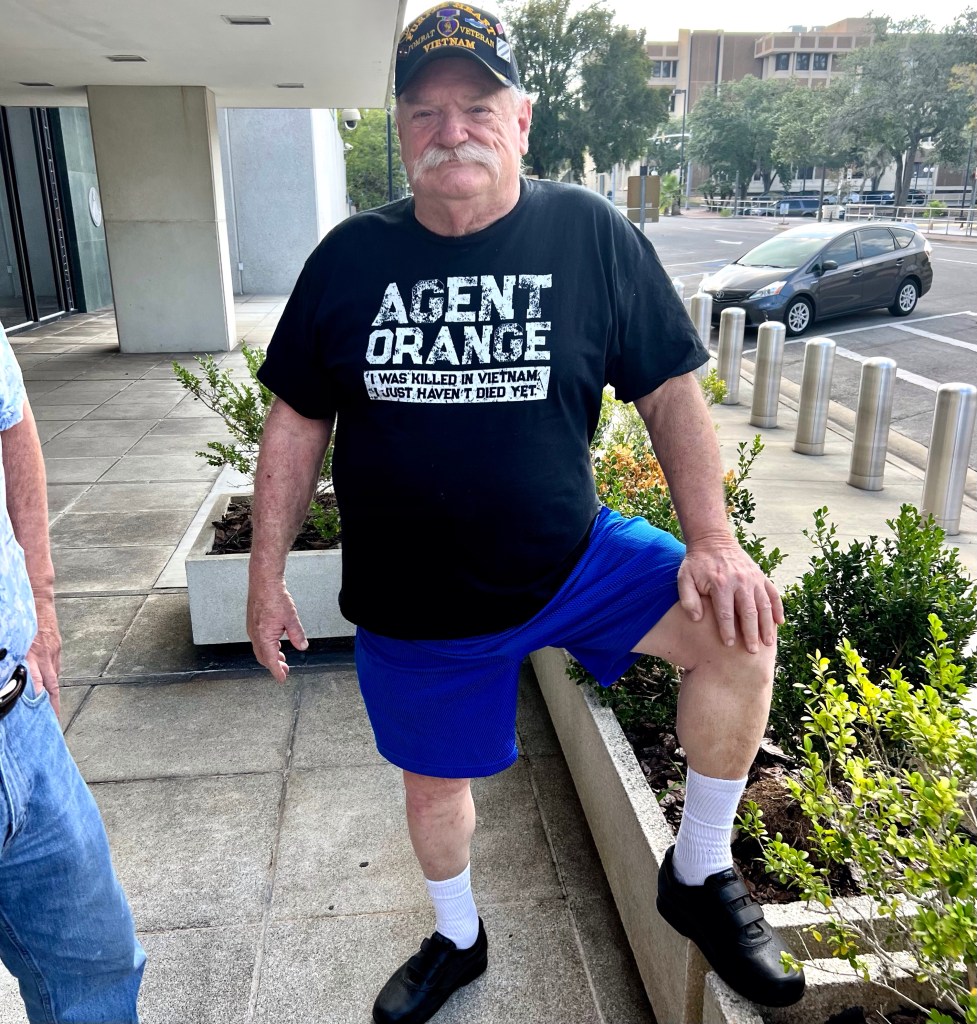
In retrospect, being the one who refused to cooperate at the cost of his liberty “showed me who I was,” reflected the former army infantry grunt. “That I have honor. That I’m willing to sacrifice for my opinion. I didn’t step away from my beliefs.”
These days however, Chambers allows that “all I want is to live out my life in peace without having to struggle to make things better for somebody else. I’m not going to jail anymore.”

 FreeGNV